


5 Ways to Integrate Health Needs of Women Undergoing Menopause in the Workplace
By Christine Butegwa*
“Raising awareness of menopause and normalizing it in the work place in the same way that pregnancy and maternity are spoken about is so important” – Prof Jo Brewis.
Women’s health from infancy to adult stage has received growing attention in the development sector as well as the formal workplace. For instance, thanks to labor laws, most work places have policies that cater for regular gynecological checks, access to family planning services, maternity and paternity leave, and childcare facilities. Very few workplaces however have policies that cover women going through menopause.
What is menopause?
Menopause occurs when a woman stops having her menstrual periods. Menopause is a natural part of aging and occurs between 45 – 55 years of age with decline of estrogen levels. Some women below the age of 40 years experience premature menopause. Women going through menopause experience symptoms that can sometimes be severe enough to affect their quality of life including contribution in the work place. Some of these severe symptoms include: hot flushes, difficulty sleeping, low mood or anxiety, depression and problems with memory and concentration. It is not uncommon for women in this age group to experience what they term as ‘brain fog’ or ‘forgetfulness’, irritability, mood swings and so on.

How does menopause affect women in the workplace?
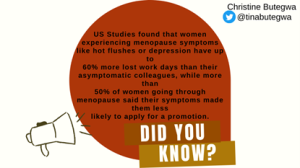
Menopausal symptoms can last anywhere from 4 years or longer after your last period. According to research by the UK Chartered Institute of Personnel and Development (CIPD), 60% of women experiencing menopausal symptoms, say that it negatively affects their work. A study in Kenya found that women in menopause had a 28% work productivity and activity impairment (Mwangi Edith, etal; African Journal of Health Sciences, 2019). US Studies found that women experiencing menopause symptoms like hot flushes or depression have up to 60% more lost work days than their asymptomatic colleagues, while more than 50% of women going through menopause said their symptoms made them less likely to apply for a promotion.
78% of menopausal women in Australia felt guilty about their perceived underperformance at the workplace; while one third took sick leave because of their symptoms (nature.com). In Japan, menopause effects on the work life of women is estimated to have cost the economy the equivalent of $3.2 billion (nature.com). Menopause can also be a significant mental health issue for women going through it.
The World Bank estimates that in 2021, the female labour force participation rate (women aged between 15 years and older who are economically active) in sub-Saharan Africa was 60%, while for Uganda it was 64%. It is therefore important that employers and work places in Africa are responsive to the health needs of their female workforce, including women going through menopause. Many women are reluctant to talk about it openly for fear of being labeled as ‘problematic’ or their symptoms being used against them in performance reviews.
According to The Guardian, in South Africa for example, over one third of women felt that there was stigma around the issue and were not comfortable talking about it at their work place. This silence is perpetuated because in many work places, especially in the public and formal sector, top and middle management is male-dominated. Women therefore fear raising health issues with their line managers.
How to Integrate Health Needs of Women Undergoing Menopause in the Workplace
Menopause is a natural phenomenon that should be normalized and not stigmatized or covered with a veil of silence, both at work and privately. It is important for work places to integrate the health needs of women undergoing menopause as more formal workplaces are seeing a rise in women occupying middle and top management including on Boards. Research has shown that women in these positions are past the reproductive age, mainly above 40 years old.
The good news is that we are now beginning to see progress in some countries as employers step up efforts to support their female staff through this life stage. Vodafone for example, which is one of the companies that has a menopause health program, has more than 31% of women in management and leadership positions globally.
Below are 5 guidelines recommended by experts, that employers can introduce to support women at the work place going through menopause:
- Include menopause health advice and hormonal therapy onto work place health insurance schemes.
- Provide flexible working arrangements to help women if they need to take time off for medical appointments or come to work later when their symptoms are bad. One of the opportunities from Covid-19 was the normalization of flexible working arrangements by many companies due to the uptake of home-based work facilitated by Internet collaborative tools. This flexibility provides women with severe menopause symptoms with the ability to work in an environment that they are more comfortable in. Access to desk fans, drinking water, good ventilation, regular showers for temperature control is easier at home.
- Tailored sick leave or absence policies so that repeated absences due to menopausal symptoms are seen as an ongoing health issue and should not affect women’s performance management processes.
- Organise health talks on menopause to help break the silence among both male and female staff
- Partner with mobile health providers that can avail health professionals on phone hotlines or web-based chats where women can self-refer for menopause advice.
What is your workplace doing to cater for the needs of different types of staff including women going through menopause? Please share your workplace strategies with me via twitter or linkedin.
*Christine Butegwa is a Gender and Development Consultant, Founder, Board Chairperson, Author and Creative.
She is CEO of Jabali Consulting.
Twitter: @tinabutegwa
LinkedIn: christine.butegwa
Post a comment
Related Posts

“You Are More Than What They See”: Dr. Edgar Twebembire’s Journey to Heal and Be Heard
Ubuntu Narrative podcast by Jabali Consulting When Dr. Edgar Twebembire walks into a hospital ward,…

Championing Justice Without Barriers: A Conversation with Agnes Dhatemwa
By Jabali Consulting team At Jabali Consulting, we believe that every story has the power…

Keynote Address by Christine Butegwa, Founder & CEO of Jabali Consulting Ltd. at the Women and Media Symposium 2023
Beyond Beijing 1995: What are the Gains, Losses and Strategies for improving Women’s Visibility Hosted…
SEXUAL EXPLOITATION, ABUSE AND HARASSMENT: ADDRESSING POWER AND PRIVILEGE IN THE WORKPLACE
Written by Christine Butegwa The workplace can be seen as a microcosm of the inequalities…